
DriveChipandPuttt finalists invited to Augusta
The USGA, Masters Tournament and PGA of America have announced that registration...


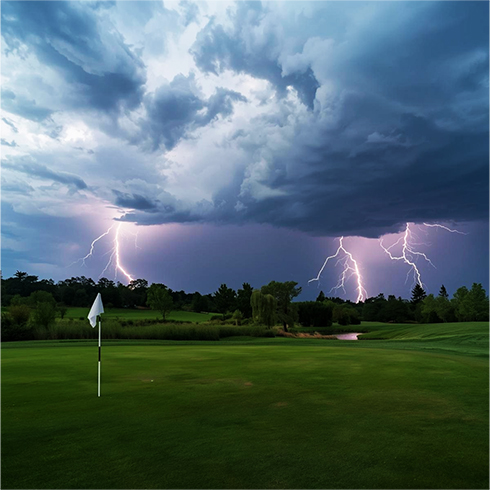
Last month the topic was Immediate Suspension of play, such as when there is imminent danger. This month’s article addresses a Normal Suspension. Normal Suspensions are implemented for situations such as darkness, or when a course becomes unplayable due to things like rain, heavy fog, or high wind. Normal Suspension of play is typically signaled by three consecutive short horn blasts.
Remember for an Immediate Suspension, a player must not make another stroke. Players may have more flexibility in deciding how they want to proceed in a Normal Suspension, depending on where each group is on the play of a hole.
For example: Cheri, Jill and Sue have just finished putting out on #4 Green and are headed to Hole #5 when they hear three short horn blasts. Because they have completed the play of Hole #4 and are between two holes, they must stop play and must not make another stroke to begin another hole until play resumes. This is true in both Stroke Play and Match Play formats.
Jim, John and Brad have a different scenario because they are in the fairway of Hole #6 when they hear the three short horn blasts. Because a player in the group has started the hole, the players get to choose if they want to stop play or play out the hole. (Having this choice is true even if they are on the Tee and only one player has teed off!) If the players choose to keep playing the hole, they can either finish the hole, or they may stop playing before completing the hole. If they choose to complete the hole, then they must not make another stroke after the hole is completed until the Committee resumes play.
But what if not everyone wants to keep playing–Now what? The answer depends on the form of play. If it is Match Play and one of the players wants to stop, then both players must not play again until play is resumed by the Committee. Stroke Play is different. Let’s go back to Jim, John and Brad. Brad and John want to stop play; Jim wants to continue. Brad is Jim’s Marker. Jim may play on ONLY if Brad stays to keep Jim’s score. Brad does not have to play, just keep Jim’s score. Jim does not have to finish the hole; he can decide to stop when he wants. Or if he does finish the hole, he must not make another stroke until play resumes.
When players stop play during a hole, the same procedure applies from an Immediate Suspension on what to do with the ball; the player can leave the ball, mark the ball’s location and lift the ball, or mark and leave the ball.

The USGA, Masters Tournament and PGA of America have announced that registration...
For the eighth time in Northwest golf history, the Pacific Northwest Golf...

By Tim Martinez, Vancouver Columbian Alistair Docherty of Vancouver picked a good...

The 2026 golf season marks a landmark year for the Washington Open...

River Ranch Golf Resort, a new destination set atop the bluffs of...

Kyra Ly of Portland, Ore. and Lauren Kim of Surrey, B.C. have...
The USGA, Masters Tournament and PGA of America have announced that registration...

Black Butte Ranch and Eagle Crest Resort in Central Oregon are teaming...

The Central Oregon Shootout is set for April 24-25 at Aspen Lakes...
By Tim Martinez, Vancouver Columbian Alistair Docherty of Vancouver picked a good...

There are plenty of reasons that the Revere Golf Club in Las...

There are certain destinations around the country that are meant for golf....

You know that you are flying into something special just by looking...

Tailored for discerning travelers, MyGolfConcierge designs custom itineraries that go beyond the...

Just because Juniper Golf Course is located in Central Oregon don’t think...